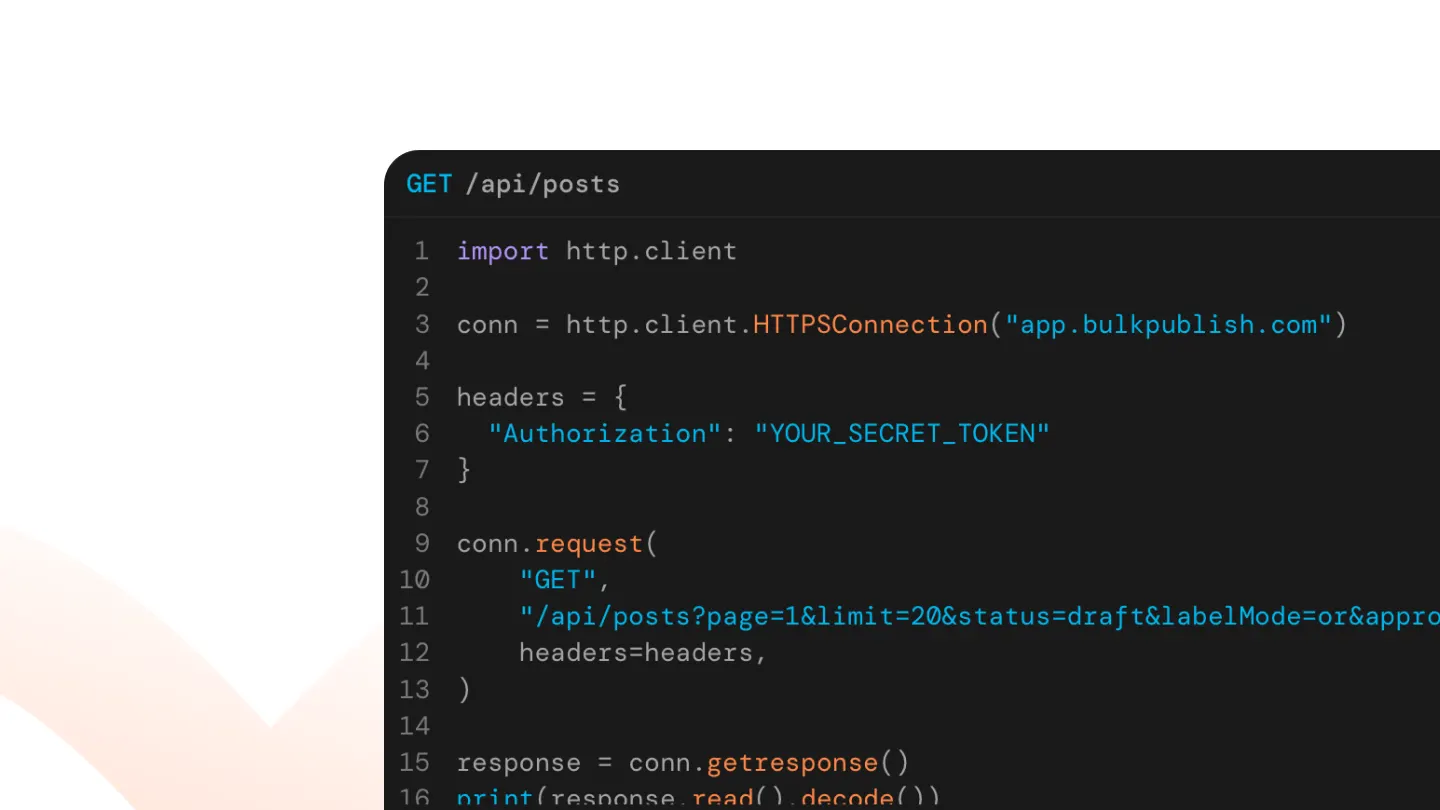

A unified social media API is one endpoint that publishes to many networks. You send a post to it, it deals with each platform’s API, and you never write an Instagram integration.
Whether that’s worth it comes down to what you’d otherwise be maintaining.
What you’re actually replacing
Integrating platforms directly is not one project. It’s a project per platform, and each one keeps going.
A separate OAuth flow each. Different scopes, different consent screens, different token lifetimes, different refresh behaviour. Some tokens expire in weeks and need refreshing on a schedule or the connection silently dies.
A separate media pipeline each. One wants a URL it fetches itself. One wants a resumable upload in chunks. One wants the video transcoded a particular way first. Sizes, durations and aspect ratios all differ.
A separate publishing model each. Some publish synchronously. Some accept the post and process it, so you poll for the result. Some fail asynchronously, meaning a 200 does not mean published.
A separate rate limit each, with its own window, its own headers, and its own behaviour when you exceed it.
A separate approval process each. Several platforms gate publishing access behind review, and that review is a thing you go through, not a key you fetch.
And it never finishes. Platforms deprecate versions, change field names and tighten permissions on their own timetable. Every one of those is unplanned work landing in your sprint.
What a unified API gives you
One authentication step, one request shape, one place where platform differences are handled. You send content, target channels and a schedule; the service handles the rest.
The good ones also give you the things you’d otherwise build around publishing: scheduling and queuing, retry on transient failure, per-platform validation before a post is sent, and a webhook when something publishes or fails.
What it can’t abstract away
Be suspicious of anything claiming otherwise.
Platform rules still apply. Character limits, media requirements and allowed post types are the platform’s, not the API’s. A good unified API surfaces them and validates against them before publishing. It cannot remove them.
Which platforms are supported is still finite. Sanctioned publishing access only exists where a platform offers it. The supported list is the product, and any provider vague about theirs is worth a second look.
Per-platform content is still your decision. The API can accept different text per platform. It can’t decide what that text should be.
When to build direct instead
Two honest cases.
If you publish to exactly one platform and always will, a direct integration is simpler and has no dependency in the middle.
If you need a deep, platform-specific surface that goes well beyond publishing, such as ad management or full comment moderation, you’ll be on the platform’s own API regardless.
For everything else, and especially anything reaching three or more networks, the arithmetic favours one integration.
The BulkPublish API
- Base URL:
https://app.bulkpublish.com - Auth: API key, or OAuth 2.1 for apps acting on behalf of other people’s accounts
- Surface: 115 documented endpoints covering posts, scheduling, media, channels, labels, analytics, RSS feeds and quotas
- Platforms: 15, including Facebook, Instagram, TikTok, YouTube, X, Threads, Bluesky, Pinterest, Google Business Profile, LinkedIn, Mastodon, Discord, Telegram, Tumblr and Snapchat
Rate limits and keys by plan:
| Free | Pro | Business | |
|---|---|---|---|
| API requests/day | 10 | 5,000 | 50,000 |
| API keys | 1 | 5 | 10 |
| The free tier’s 10 requests a day is enough to evaluate the API and run a light personal automation. It is not enough to run a production pipeline, which is deliberate. |
There are Node and Python SDKs, a Postman collection, and an MCP server if the caller is an AI assistant rather than your code.
The short version
A unified social media API replaces one OAuth flow, one media pipeline, one publishing model and one rate limit per platform with a single integration, and it absorbs the platform changes that would otherwise be your problem. It cannot remove the platforms’ own rules, and it cannot support a platform that doesn’t offer access. Past about three networks, it’s straightforwardly less work.