Social Media for Musicians (2026)
What to post around a release, how often, and which platforms actually turn viewers into listeners and ticket buyers. A practical guide for musicians and bands.
194 posts
What to post around a release, how often, and which platforms actually turn viewers into listeners and ticket buyers. A practical guide for musicians and bands.
What to post between episodes, how often, and which platforms actually send listeners to a show. A practical guide for podcasters.
Meta documents Facebook Feed ranking in four stages and publishes what it demotes. Here is what is confirmed, what is not, and what moves reach.
Facebook post length, Reels duration, scheduling windows and API publishing caps, plus the friend request and group limits Meta does not publish.
TikTok does not use one fixed maximum video length. Here is what the API actually returns per creator, and why the ceiling differs between accounts.
YouTube Shorts can be up to 3 minutes long. What qualifies a video as a Short, what happens at the boundary, and how long a Short should actually run.
Instagram Reels run from 3 seconds to 15 minutes according to Meta's own API documentation. Here is the full spec and how long a Reel should actually be.
DataReportal counts 5.79 billion social media identities in 2026, about 70% of the world. Here is why that is accounts, not people, and what it hides.
Published freelance rates run from $20 to over $200 an hour. Here is how to price hourly, retainer and per-project work, with a retainer worked out from hours.
A per-platform frequency table, why the numbers differ, and the four-week test that tells you your own cadence instead of copying someone else's.
Bluesky tolerates a high cadence. Most active accounts post 3 to 10 times a day. Here is the breakdown by format and how to find your own number.
Most Pages do well on 3 to 7 posts a week, roughly one a day at the top end. Here is the cadence by format and how to find your own number.
Most accounts do well on 3 to 5 feed posts a week plus stories on most days. Here is the cadence by format, and how to find your own number.
LinkedIn's own advice for Pages is at least one update per weekday. Personal profiles usually do best on 2 to 5 posts a week. Here is the full breakdown.
Pinterest advises creating original content weekly. In practice most accounts run 1 to 5 fresh Pins a day. Here is the cadence and the spam risk to avoid.
Most active Threads accounts post 1 to 5 times a day. Here is the cadence by format, why replies matter more than posts, and how to find your own number.
Most growing accounts post once a day, and the common advice range runs from 3 a week to 3 a day. Here is the cadence by format and how to test yours.
X tolerates a higher cadence than any other network. Most active accounts run 2 to 5 posts a day. Here is the breakdown by format and how to find yours.
One long-form video a week is the standard baseline, with Shorts running at 3 to 7 a week. YouTube says consistency matters more than frequency.
Every major feed does the same four things. What each platform officially confirms, which popular claims have no source, and what actually moves reach.
A realistic route into social media management: the skills that get hired, the portfolio that beats a certificate, and what the first year actually looks like.
A three-hour block broken into nine 20-minute stages that produces a full month of social posts, scheduled, with the mix checked before you publish.
Where social media time really goes, measured by task, and the eight changes that cut it, with realistic time saved for each and what not to bother with.
Instagram runs a separate ranking system per surface. Here is what Instagram itself states, what is only reported, and what actually moves reach.
Instagram median engagement sits between 0.30% and 0.48% by followers in 2026, depending on the study. Here is the data, by format and by account size.
Every Instagram limit worth knowing: caption length, carousel size, Reels and Stories duration, API posting caps, and what Instagram refuses to publish.
Instagram passed 3 billion monthly users and 2 billion daily users. Here are the sourced 2026 figures on size, US adoption, engagement and format mix.
Instagram Story videos run 3 to 60 seconds with a 100 MB file cap. The documented specs, how longer videos get split, and how long Stories stay up.
Fifteen full LinkedIn About section drafts, opening to close, organised by what you want the profile to do: hire, get hired, sell or switch fields.
LinkedIn Engineering published its feed ranking architecture in March 2026. Here is what it states, what is only reported, and what moves reach.
LinkedIn company pages averaged 5.20% engagement by impressions in 2026, with native documents at 7.00%. Here is the format breakdown and the formula.
LinkedIn post length, video duration and file size, document and image rules, plus what LinkedIn does and does not publish about connection limits.
Pinterest publishes what helps and hurts Pin distribution. Here is what it states, what is only reported, and what actually moves impressions.
Pinterest Pin title and description limits, video duration and file size, carousel counts and board caps, with the daily pinning limits Pinterest hides.
A full social media audit template you can copy inline: account inventory, performance tables, content review, competitor check and a fix list.
A social media brand guidelines template you can copy inline: voice, visual rules, per-platform specifics, caption formatting and accessibility.
Copy-and-paste social media checklists with time estimates: a 15-minute daily list, a 45-minute weekly one, a monthly one and a pre-publish check.
How to batch social media content properly: the four stages, time estimates per stage, batch sizes that hold up, and where batching goes wrong.
Median engagement rates by platform from two 2026 studies, why they disagree, and the four different formulas hiding behind the word "engagement rate".
How independent creators actually run their platforms: one home platform, repurposing that is not lazy, and a posting rhythm that survives a bad week.
How to run brand and local accounts together: what head office should own, what each location should control, and how approvals keep both sides honest.
A practical guide for school communications: consent and photo permissions, who is allowed to post, the academic year calendar, and what to do in a crisis.
A freelance social media manager contract template you can copy inline: scope, fees, revisions, account access, IP ownership and termination.
Real interview questions for social media manager roles, grouped by what they test, each with a note on what a strong answer contains. Plus what candidates should ask back.
A social media manager job description you can copy, edit and post, plus the requirements most listings include that quietly cost you good candidates.
The six tool categories a social media manager actually needs, what belongs in each, and which ones most people can skip for the first year.
The major salary trackers disagree about social media manager pay by tens of thousands of dollars. Here is every published range, and what explains the spread.
A social media policy template for employees, copyable inline, covering personal accounts, brand accounts, confidentiality, escalation and access.
A posting schedule template you can copy inline, with slot grids for one to four channels, how to choose times, and how to test them properly.
A complete social media proposal template you can copy inline: scope, deliverables, pricing tables, timeline and the terms that prevent scope creep.
A complete monthly social media report template you can copy inline, with the tables, the placeholders, and how to fill in each section honestly.
A realistic social media setup for a business with no marketing team: which platforms to pick, how much to post, and how to batch a month in one sitting.
How to run social accounts you do not own: access without password sharing, approvals that protect you, and a clean handoff when a client leaves.
Sourced social media statistics for 2026: user numbers from company filings, adoption data from Pew and DataReportal, and engagement medians with formulas.
A one-page social media strategy template you can copy inline: goals, audience, pillars, channel plan, cadence and the measurement section.
Maximum video length on every major platform in one table, from Facebook Reels at 90 seconds to X at 125 minutes for Premium, with the file size caps.
A social media workflow that survives contact with a real week: six stages, owners, time per stage, handoff rules and where workflows usually break.
Threads has the thinnest official documentation of any major feed. Here is the little Meta confirms, what is only reported, and what moves reach.
Threads post length, video duration, carousel size, link limits and the 250 posts per day API cap, all from Meta's own Threads API documentation.
TikTok publishes its own explanation of the For You feed. Here is what it states, what it explicitly rules out, and what really moves reach.
TikTok medians run from 2.01% to 3.85% in 2026 depending on whether the study divides by followers or by views. Both numbers, with the arithmetic.
TikTok caption, video duration, upload and API posting limits in one place, plus a straight answer about the follow and like limits TikTok never publishes.
TikTok has not published a user number since 2021. Here is what is actually verifiable in 2026, and what every big TikTok statistic is really estimating.
A good engagement rate depends entirely on which formula you used. Here are the medians, the arithmetic, and the honest answer about what counts as good.
Pick two platforms, not eight. A comparison of the major networks by audience, format, effort and API access, with a straight answer for each type of business.
X post length, video duration, file size and API posting limits in one table, including the differences between free accounts and Premium.
YouTube says it recommends videos, not channels, using hundreds of signals. Here is what YouTube states, what is only reported, and what moves views.
YouTube upload length and file size, Shorts duration, description limits and the daily API quota that governs how many videos a tool can publish.
60 aesthetic Instagram bio ideas grouped by mood, from soft and minimal to coastal and dark, with formatting that stays readable.
60 attitude status ideas grouped by tone, from cold and short to confident and funny, written for people who already know you.
60 Instagram bio ideas with emoji, grouped by account type, plus how many to use before a profile becomes hard to read.
60 birthday status ideas grouped by who they are for, your own birthday, friends, family and milestone years.
60 business Instagram bio examples grouped by industry, for shops, cafes, services and creators, plus what earns a tap.
60 call to action examples for social media, grouped by goal, from saves and comments to clicks and purchases, without the hard sell.
55 specific social media content ideas grouped by category, usable across platforms, with a system for building a repeatable rotation.
60 Discord bio examples grouped by type, for gamers, artists, server owners and study servers, plus what to keep private.
Yes, but not the way they used to. Hashtags now classify posts for ranking systems rather than driving direct discovery.
60 Facebook status ideas grouped by situation, from everyday updates and good news to asking for help and local posts.
60 funny status ideas grouped by situation, from household chaos and work to sleep and shopping, short enough to read at a glance.
Instagram allows up to 30 hashtags per post, but using all 30 is not a strategy. A smaller relevant set works better.
Two real methods to keep hashtags out of your visible caption on Instagram, and why neither hides them from ranking.
60 Instagram bio ideas for boys grouped by style, from attitude and sports to funny and simple, short enough to fit.
60 Instagram bio ideas for girls grouped by style, from soft and aesthetic to funny and confident, plus how to make one yours.
A practical guide to writing Instagram captions, plus a broad set of ready-to-use examples for almost any post.
60 LinkedIn headline examples grouped by role and situation, for job seekers, freelancers, founders and career changers.
60 LinkedIn summary and About section examples grouped by career stage, plus a method for writing one that people finish.
60 love status ideas grouped by stage, from new relationships and long ones to distance and quiet everyday affection.
60 motivational status ideas grouped by situation, written to sound like a person rather than a poster, for real audiences.
60 Pinterest bio examples grouped by account type, for bloggers, shops, creators and hobby boards, written for Pinterest search.
60 short status quotes grouped by mood, one line each, for WhatsApp, Facebook and anywhere a long post would be too much.
60 Snapchat bio examples grouped by mood, from funny and short to aesthetic and couple bios, for a profile people see fast.
Every platform character limit in one table, from X's 280 to Reddit's 40,000, plus what actually counts toward each one.
What to post as an author, how often, and which platforms actually sell books instead of just collecting followers.
What to post as a cafe or coffee shop, how often, and which platforms actually turn a good photo into a customer walking in.
What to post as a coach or consultant, how often, and which platforms actually turn followers into paying clients.
What to post as a dental practice, how often, and which platforms actually build trust with prospective patients.
What to post as a gym or fitness studio, how often, and which platforms actually turn followers into new members.
What to post as a hotel or short-term rental, how often, and which platforms actually turn scrolling into a booking.
What to post as a local retail shop, how often, and which platforms actually bring people through the door.
What to post as a nonprofit, how often, and which platforms actually turn followers into donors and volunteers.
What to post as a personal trainer, how often, and which platforms actually convert followers into paying clients.
What to post as a photographer, how often, and which platforms actually convert an audience into booked clients.
What to post as a real estate agent, how often, and which platforms actually bring in leads instead of just likes.
What to post as a salon or barbershop, how often, and which platforms actually fill the chair with new clients.
60 Threads bio examples grouped by account type, from personal accounts to businesses, with what belongs in a short profile.
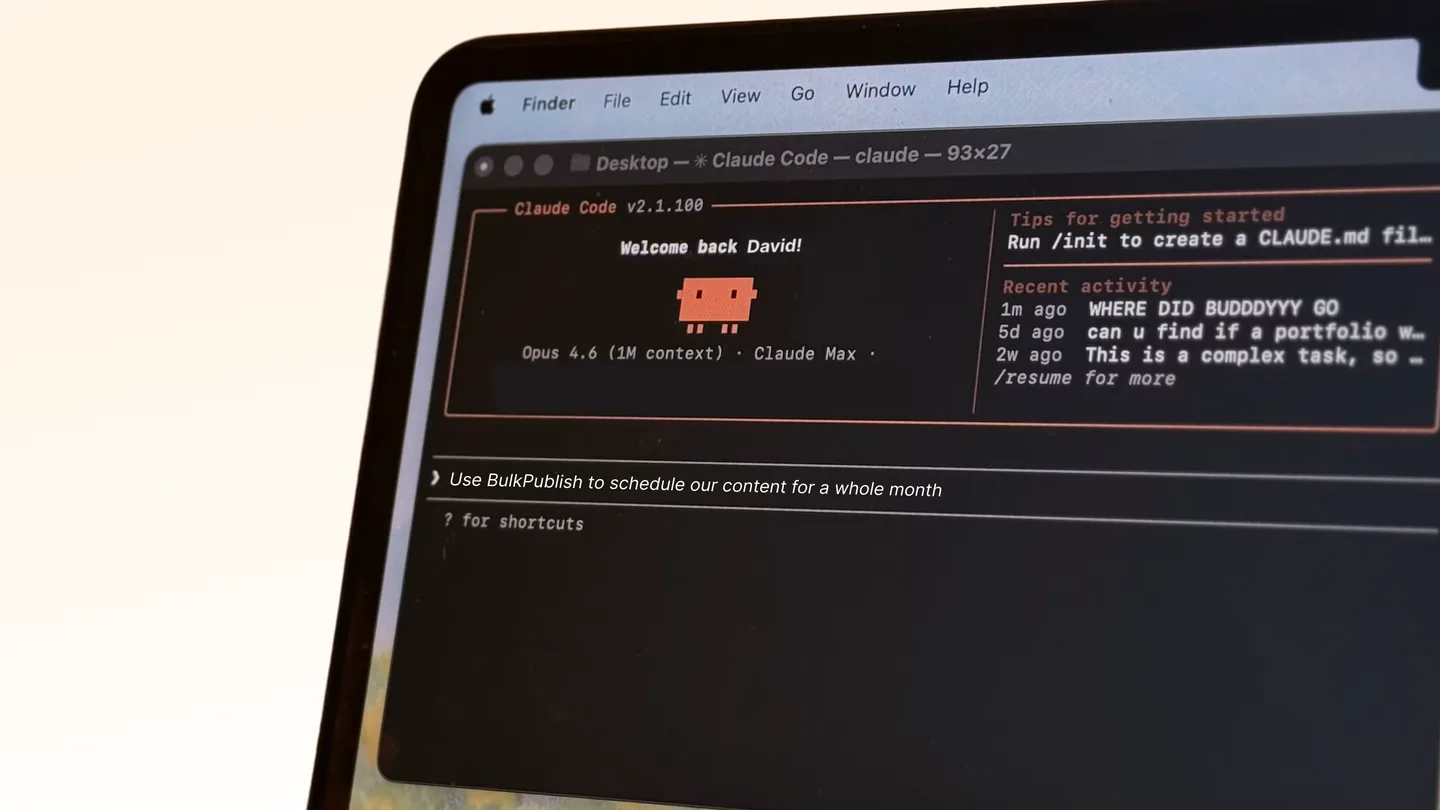
60 WhatsApp status ideas grouped by mood, from short and funny to busy, tired and celebratory, for people who already know you.
60 YouTube channel description examples grouped by channel type, plus what to put in the first line that shows in search.
Turn an Airtable content calendar into scheduled posts. The field setup, the status gate, and why writing back matters more than you think.
An honest breakdown of what building direct platform integrations costs, what it keeps costing, and the cases where building is still right.
Queue a month of Instagram content in one sitting, including the media limits that decide whether a batch imports cleanly.
Batching works well on LinkedIn because the platform rewards consistency more than immediacy. Here is the workflow and what not to queue.
Writing a month of posts in one sitting beats writing one a day. Here is how batching works, where it breaks down, and how to queue a batch across several platforms at once.
Batching TikTok means batching video, so storage and the native 10-day ceiling are the two things that shape the workflow.
Queue a batch of posts and threads on X, with the 280-character discipline that lets the same batch cover three other networks.
Bluesky has no built-in scheduler, so yes but only through a third-party tool. Here is what the protocol allows and how scheduling works.
Yes. What a Facebook Story needs, which ones are worth queueing ahead, and how to publish to Instagram Stories from the same upload.
Yes, across all three post types. Here is what each is for, and why scheduling matters more here than on a normal social platform.
Yes, up to 10 images per carousel. Here is what to know about ordering, the per-image size limit, and why carousels are worth batching.
Yes, across all five Instagram formats. Here is what each needs and the two limits that cause most scheduled posts to fail.
Yes. Here is what a Reel needs before it can be queued, and the file limit that catches people scheduling video for the first time.
Yes, Stories can be queued in advance. The more useful question is which Stories are worth scheduling, given they disappear.
Yes. LinkedIn carousels are PDFs, which is the detail that changes how you make them. Here is how to build and schedule one.
Yes, LinkedIn schedules natively from 10 minutes to 3 months ahead. Here is what it covers, which post types it refuses, and the time zone catch.
Yes, Pinterest schedules Pins up to 30 days ahead, but only one at a time and only 10 in the queue. Here is what that means in practice.
Yes. What Threads accepts, how threading works, and why its 500-character limit makes it the easy one in a short-text cross-posting set.
Yes, TikTok has a built-in scheduler, but it only works on the web, needs a Business Account and caps out at 10 days. Here is what it does and where it stops.
Yes, including threads. Here is what X accepts, and why third-party X scheduling is priced differently from every other platform.
YouTube schedules uploads natively, and a Short is an upload. Here is how the scheduling flow works and what YouTube does and does not say about Shorts.
The file transfers unchanged. The watermark, the caption and the hashtags do not. Here is how to do it without it being obvious.
The same file works on both, but the text does completely different jobs. Here is why the YouTube description deserves real effort.
The two are the easiest pair to link and the easiest to get wrong, because the forwarded copy keeps the hashtags and the link-in-bio.
The two platforms with the widest gap in register. Here is how to publish to both from one draft without the LinkedIn post reading as a tweet.
Both are short-text networks with similar rhythms, but 500 characters does not fit in 300. Here is how to publish to both without truncation.
Going TikTok-first has one specific trap that going the other way does not. Here is how to publish to both without the TikTok watermark following you.
Twenty characters separate them, so one draft covers both. Here is the workflow, and the parts that do not transfer.
Evergreen scheduling keeps your best content circulating instead of letting it disappear. Here is how to build a rotation that does not look automated.
Publish from a spreadsheet with n8n, the row-tracking problem nobody warns about, and when a CSV import is the better answer.
Plan posts in a spreadsheet and let Zapier publish them. Here is the Zap, the sheet structure that makes it reliable, and when a CSV import is simpler.
Automatic reposting works for a narrow set of content and embarrasses people with everything else. Here is the line between them.
What building one actually involves beyond the queue: the platform work, the states you need, and the parts that never stop costing you.
Most content calendars die within a month. Here is how to build one small enough to survive, and what actually belongs in it.
A practical walkthrough for publishing one post across several social networks without it reading as copy-paste, including what to adapt per platform and what to leave alone.
OAuth for social platforms is a per-platform project that never finishes. Here is what it actually involves and how to avoid most of it.
Giving an assistant the ability to publish is mostly a question of scoping and review. Here are the three ways to connect one, and the guardrails worth setting first.
Running more than a handful of accounts is an organisation problem before it is a posting problem. Here is a structure that holds up as the number grows.
Three ways to publish one post to every social network you use: the native options, the scheduling tools, and the API route, with the limits of each.
Connect Claude to a publishing tool and it can draft, schedule and check posts in conversation. Here is the setup and the guardrails worth having.
Bluesky has no built-in scheduler, so scheduling means a third-party tool. Here is what the platform accepts and how to queue posts and threads.
Scheduling messages to a Discord channel, how the webhook connection works, and why Discord needs a different tone from the rest of your queue.
Facebook Pages support scheduling through Meta's own tools. Here are the three formats, the very large text allowance, and how it fits with everything else.
Google Business Profile posts show up next to your listing in Search and Maps. Here are the three post types, what they accept, and what to schedule.
The five Instagram formats you can schedule, what each one requires, and the media rules that decide whether a post publishes or fails.
LinkedIn schedules natively up to three months ahead. Here is what it covers, the four post formats, and when a separate tool earns its place.
Mastodon is federated, so scheduling works a little differently. Here is what posts accept, why your instance matters, and how to queue in advance.
Pinterest schedules natively but caps the queue at 10 Pins. Here is what that means for anyone pinning regularly, and what the platform accepts.
Snapchat publishing covers Stories, Saved Stories and Spotlight. Here is what each accepts, the very short caption limit, and how scheduling works.
Posting to a Telegram channel on a schedule, what the bot connection means, and the media limit that catches people out.
What Threads accepts, how to queue posts and threads in advance, and how it compares to the other short-text networks you are probably also posting to.
Two ways to schedule TikTok: the native web scheduler with its 10-day ceiling, or a tool that also covers Reels and Shorts from the same upload.
Tumblr has the most generous text allowance of any major network. Here is what it accepts, how to queue posts, and what to do with all that room.
Scheduling posts on X, the 280-character reality, when to thread, and what to know about the API costs that shape third-party tools.
A Short schedules like any other upload. The part worth automating is getting the same vertical video onto TikTok and Reels at the same time.
YouTube schedules from the upload flow itself. Here is how it works, what the Premiere option adds, and when to publish the announcement elsewhere too.
Running several brands is mostly about keeping them properly separate. Here is the structure, and the specific mistake it exists to prevent.
Platform schedulers are free and often good. Here is where they stop, using four platforms' documented limits, and when moving off them is worth it.
Plan content in a Notion database and publish it automatically. The property setup that makes it reliable, and the status gate you need.
Publish from a Notion database with a Zap, the status gate that stops drafts going out, and the rich-text problem that produces odd-looking posts.
Short answer: yes, with caveats. Here's what a single publishing app can and can't do across 15 networks, and where the limits come from.
Three platforms, three registers, one workflow. Here is what each accepts and which parts of a post genuinely have to change.
One vertical video, three platforms. Here is what each accepts, why the captions should differ, and how to publish all three from one upload.
Post to 15 networks from Node with one API call. Working examples for creating, scheduling and attaching media, plus the mistakes worth avoiding.
There is no PHP SDK, so this is the REST API directly. Working cURL and Guzzle examples for creating, scheduling and checking posts.
Post and schedule across 15 networks from Python. Working examples, the per-platform fields that are actually required, and how to avoid surprises.
Recurring posts republish on a schedule instead of once. Here is what they are good for, what they are terrible for, and how the frequencies work.
How to turn an RSS feed into social posts with n8n, plus an honest note about when the built-in feed reader does the job without a workflow at all.
Turn a feed into posts with a Zap, plus the built-in option that may make the Zap unnecessary, and the filter step most people skip.
If you plan content in a spreadsheet, you should not be retyping it into a composer. Here is the column format, what happens to bad rows, and the limits worth knowing.
If your users want to publish from inside your product, this is what the integration actually involves and which auth model to choose.
Rate limits exist at two levels when you publish through an API, and the one people forget is the platform's. Here is how to design around both.
Make scenarios for social publishing, where its visual model helps, and the error handling that stops a scenario failing silently.
A five-column template that imports straight into a scheduler, with what each column is for and why it is deliberately small.
A content calendar is a commitment about the future, not a spreadsheet. Here is what belongs in one, what does not, and where it should live.
Most of your audience never saw your best post. Recycling fixes that, as long as you avoid the three ways it goes wrong.
A three-column CSV template for planning and importing social posts, plus what each column does and the quoting rules that stop imports breaking.
What changes when you go from three accounts to thirty, and the features that stop it becoming a filing problem.
How scheduling works when you publish through an API: time zones, states, what happens when a platform is down, and the model to build against.
One endpoint that publishes to every network, instead of fifteen integrations you maintain forever. Here is what it replaces and what it cannot hide.
MCP is how AI assistants talk to outside tools. Here is what a server does, why the protocol exists, and what it means for you as a user rather than a developer.
Cross-posting means publishing one piece of content to several social platforms. Here's what it actually involves, when it works, and when it quietly costs you reach.
Announce new WordPress posts across your social accounts automatically, with the filtering and rewriting that stops it reading like a bot.
Announce new WordPress posts automatically, with the filter that stops it broadcasting everything and the reason not to post the headline.
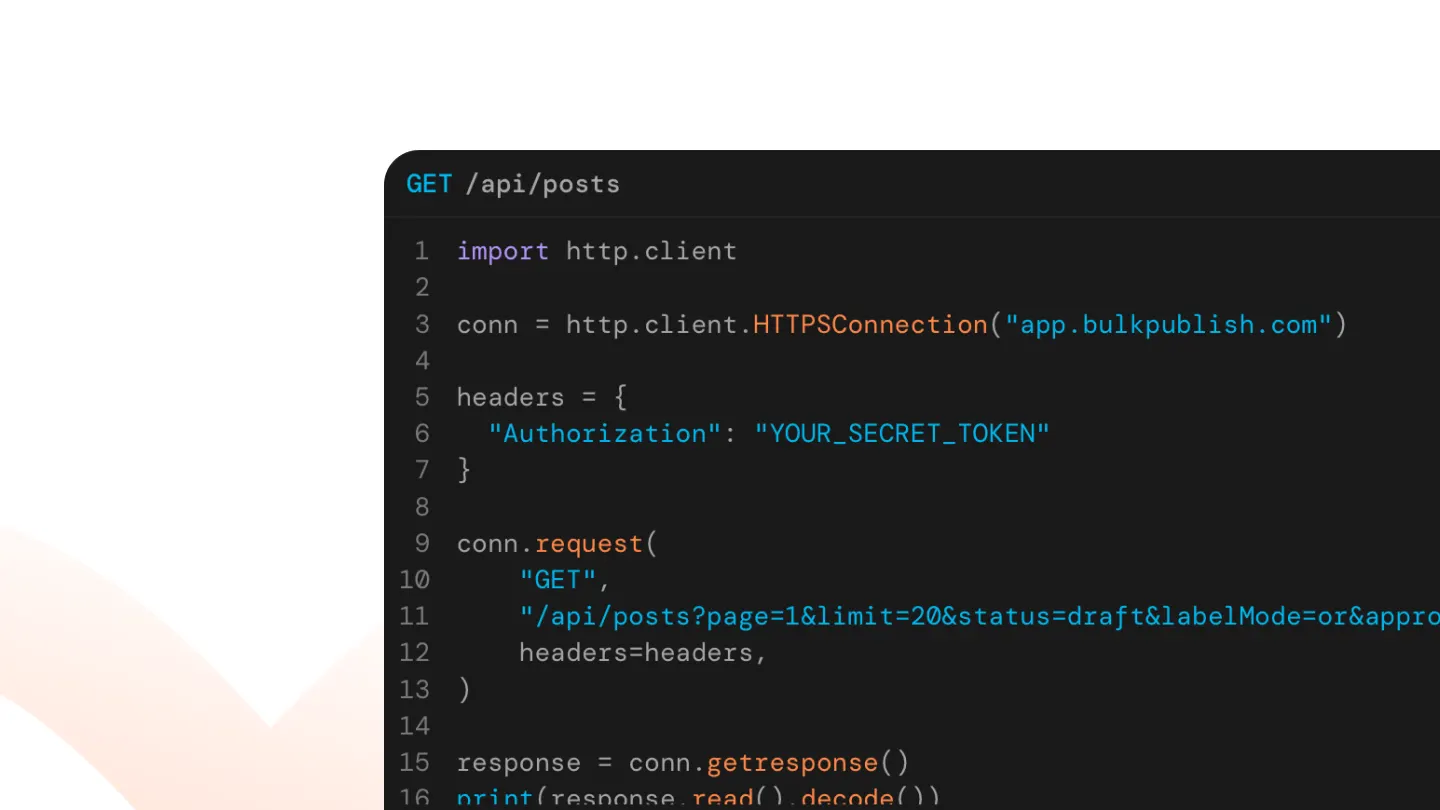
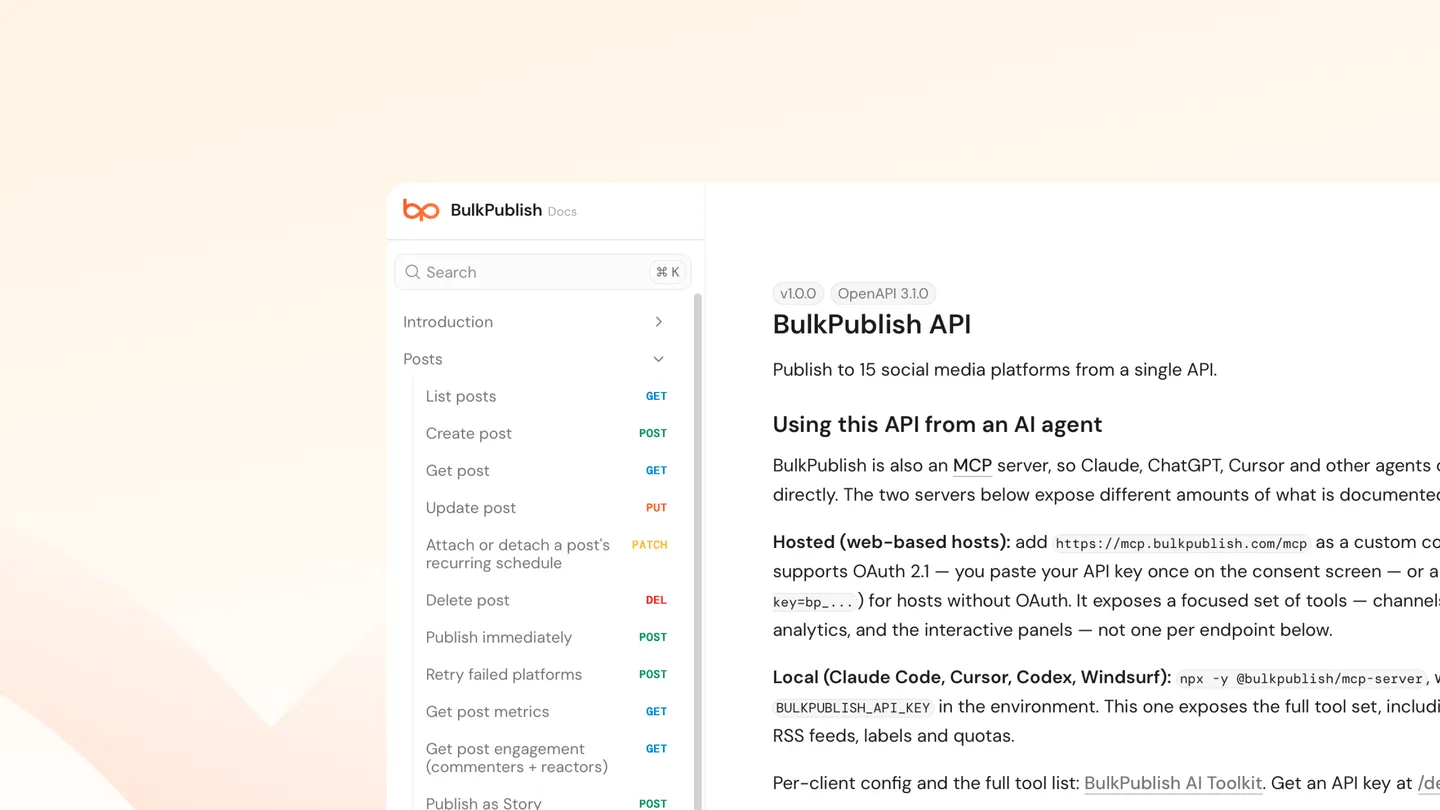
A practical guide to using the BulkPublish API for programmatic social media scheduling, bulk content uploads, and custom integrations.
Learn how to bulk publish content to multiple social media platforms at once. Step-by-step guide covering setup, customization, and advanced tips.
Learn how to schedule social media posts across multiple platforms with this step-by-step guide. Covers setup, scheduling, and tips for consistency.