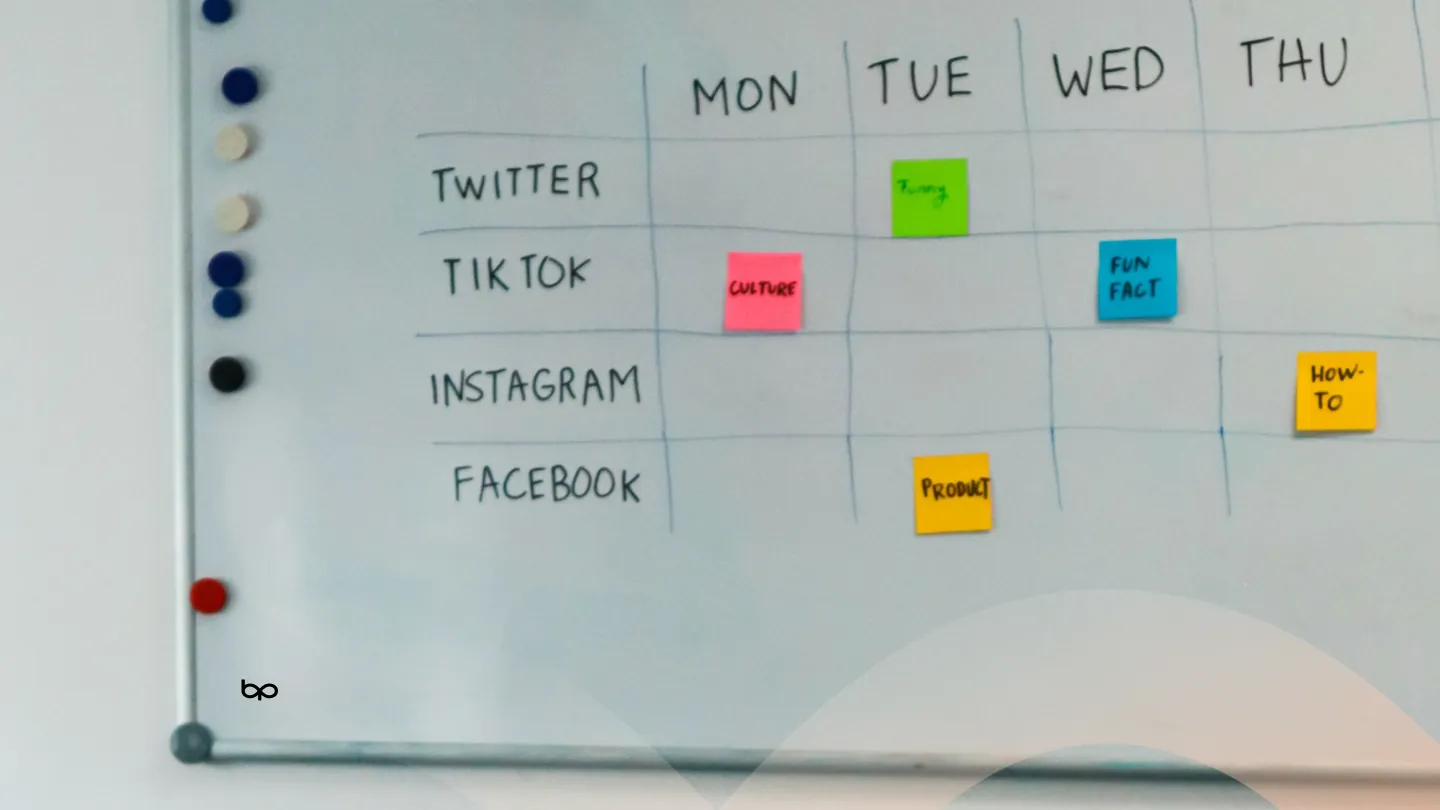

Brand guidelines for social media are not the corporate brand book. The brand book covers logos and print. This document answers the question a freelancer has at 4pm on a Tuesday: can I write it like this, and can I post it like that.
Below is the whole template, inline and ungated. It is deliberately written to be readable in ten minutes by someone new.
The template
# Social Media Brand Guidelines: [BRAND NAME]

**Version:** [X.X]  **Updated:** [DATE]  **Owner:** [NAME, ROLE]
**Questions:** [EMAIL / CHANNEL]

---

## 1. In one line

[BRAND] is [WHAT IT IS] for [WHO], and on social we sound like [DESCRIPTION].

---

## 2. Voice

**We are:** [ADJECTIVE], [ADJECTIVE], [ADJECTIVE]
**We are not:** [ADJECTIVE], [ADJECTIVE], [ADJECTIVE]

| Instead of | Write |
|---|---|
| [OVER-FORMAL EXAMPLE] | [OUR VERSION] |
| [HYPE EXAMPLE] | [OUR VERSION] |
| [JARGON EXAMPLE] | [OUR VERSION] |

**Words we use:** [LIST]
**Words we never use:** [LIST, e.g. banned buzzwords, competitor names,
superlatives you cannot substantiate]

**Person:** we say "[we / I / the team]" and address the reader as "[you]".
**Humour:** [YES/NO, and the boundary]
**Emoji:** [Freely / sparingly / never]. Never [WHERE, e.g. in the first line].
**Profanity:** [RULE]
**Exclamation marks:** [RULE, e.g. one per post maximum]

---

## 3. What we talk about

| Pillar | Description | Share of posts | Example post |
|---|---|---|---|
| [PILLAR] | [DESCRIPTION] | [X%] | [EXAMPLE] |
| [PILLAR] | [DESCRIPTION] | [X%] | [EXAMPLE] |
| [PILLAR] | [DESCRIPTION] | [X%] | [EXAMPLE] |
| [PILLAR] | [DESCRIPTION] | [X%] | [EXAMPLE] |

**Topics we avoid:** [LIST, e.g. party politics, competitor comparisons,
unverified claims, anything under legal review]

---

## 4. Captions

**Structure**
1. Line one: [THE HOOK RULE, e.g. a claim or question, no greeting]
2. Body: [LENGTH GUIDANCE PER PLATFORM, see section 6]
3. Call to action: [ONE, and only where it is genuine]

**Rules**
- Front-load the point. The first line is what people see before "more".
- One idea per post.
- No "link in bio" unless the link is actually in the bio that day.
- [HASHTAG RULE: how many, where, which ones. List the standing set.]
- [MENTION RULE: when we tag partners, customers, employees.]
- [CLAIMS RULE: which claims need approval from [ROLE].]

**Standing hashtags:** [LIST]
**Never use:** [LIST]

---

## 5. Visual rules

| Item | Rule |
|---|---|
| Logo | [WHERE IT APPEARS, WHERE IT DOES NOT, CLEAR SPACE] |
| Primary colours | [NAME] [HEX], [NAME] [HEX] |
| Secondary colours | [NAME] [HEX], [NAME] [HEX] |
| Text on image | [FONT], [SIZE RULE], [MAX WORDS] |
| Photography style | [DESCRIPTION: lighting, subjects, what to avoid] |
| Illustration style | [DESCRIPTION or "not used"] |
| Video | [Intro rule, subtitle rule, end card rule, music licence source] |
| Templates | [LINK TO FILE / FOLDER] |
| Asset library | [LINK] |

**Never:** [stretch the logo, put text over faces, use unlicensed stock, use
last year's product screenshots, etc.]

---

## 6. Per-platform notes

| Platform | Role | Formats we post | Caption length | Cadence | Anything specific |
|---|---|---|---|---|---|
| [PLATFORM] | [Primary/Support] | [FORMATS] | [GUIDANCE] | [N/week] | [NOTE] |
| [PLATFORM] | [ROLE] | [FORMATS] | [GUIDANCE] | [N/week] | [NOTE] |
| [PLATFORM] | [ROLE] | [FORMATS] | [GUIDANCE] | [N/week] | [NOTE] |

**Image and video specifications:** see [LINK TO A LIVE SPEC SOURCE]. Do not
copy dimensions into this document; platforms change them and a stale number
here becomes a cropped post.

---

## 7. Accessibility

- Alt text on every image. Describe the content, not the mood. [MAX LENGTH]
- Captions or subtitles on every video with speech.
- Camel case in multi-word hashtags: #SocialMediaWeek, not #socialmediaweek.
- Do not carry meaning in colour alone.
- Contrast: text on image must remain legible at thumbnail size.
- Avoid decorative unicode fonts. Screen readers read them character by
  character or not at all.

---

## 8. Replies and community

**Tone in replies:** [DESCRIPTION, usually warmer and shorter than posts]
**Response time target:** [HOURS] on [DAYS]
**We always reply to:** [QUESTIONS, COMPLAINTS, MENTIONS BY PARTNERS]
**We never reply to:** [TROLLS, SPAM, [OTHER]]
**Escalate to [ROLE]:** [LEGAL, SAFETY, PRESS, ANYTHING VIRAL AND NEGATIVE]

---

## 9. Approval

| Content type | Approver | Lead time |
|---|---|---|
| Routine post | [ROLE] | [N] days |
| Anything with a product claim | [ROLE] | [N] days |
| Anything referencing a customer | [ROLE + CUSTOMER] | [N] days |
| Crisis or response post | [ROLE] | Immediate |

---

## 10. Examples

**Good post, and why**
> [PASTE A REAL POST]
Why: [ONE OR TWO LINES]

**Post that missed, and why**
> [PASTE A REAL POST]
Why: [ONE OR TWO LINES]

Keep at least three of each and update them quarterly.
How to fill each section in
Section 2 is the section that changes behaviour, and only because of the “instead of / write” table. Adjectives alone (“friendly, confident, human”) produce no measurable difference in output. Three rewritten sentences do. Take them from real posts, including your own bad ones.
Section 3. The share-of-posts column is what stops a brand quietly becoming 80% product promotion. If you have not defined pillars, our content pillar generator gives you a starting set to argue with.
Section 4. The first line rule is the highest-leverage item in the whole document, because every platform truncates. A caption analyzer is useful for checking where the cut-off lands and whether your hook survives it.
Section 5. Link to the template files rather than describing them. A guideline that requires someone to rebuild a layout from prose will be ignored.
Section 6 deliberately does not list pixel dimensions. Platforms change them without announcements, and a stale table here silently ruins a month of crops. Point at a source that is maintained.
Section 7. Accessibility rules belong in the guidelines, not in a separate document nobody opens. The camel case hashtag rule and the unicode font rule are the two most often missed.
Section 10. Real examples with reasons attached teach faster than every other section combined. Refresh them quarterly, because a two-year-old example teaches a two-year-old style.
What most people get wrong
Copying the print brand book. Logo clear-space rules do not tell anyone how to write a caption. This document should be almost entirely about writing and behaviour.
Adjectives without examples. “Authentic and bold” means nothing to the freelancer who starts on Monday.
Baking in image dimensions. They go stale, and unlike a wrong colour hex, nobody notices until posts are cropped.
No approval matrix. Section 9 is what stops every post waiting on one person and product claims going out unchecked.
Fifty pages. If it cannot be read in ten minutes, it will be read by nobody. Everything long belongs in a linked file.
Never updating the examples. Section 10 is the only part that decays on its own.
Confusing it with policy. Conduct, confidentiality and escalation for the whole company belong in a social media policy. This document is for the people making the content.
Keeping guidelines attached to the work
Guidelines fail at the moment of writing, not at the moment of reading, which is why the useful version lives next to the drafts rather than in a folder.
Two things help in practice. Keep approved templates and cleared imagery in one media library so nobody hunts for last year’s file, and put the section 9 matrix into an actual approval step so the right reviewer sees a post before it is live rather than after. If several brands share a team, labels and channel sets keep each brand’s material from turning up in the wrong queue.
The short version
Ten sections, ten minutes to read. Voice defined by rewritten examples, not adjectives. Pillars with percentages. A caption structure with a first-line rule. Visual rules that link to templates. Per-platform notes that link out for dimensions rather than restating them. Accessibility included. An approval matrix. Three good examples and three bad ones, refreshed quarterly.