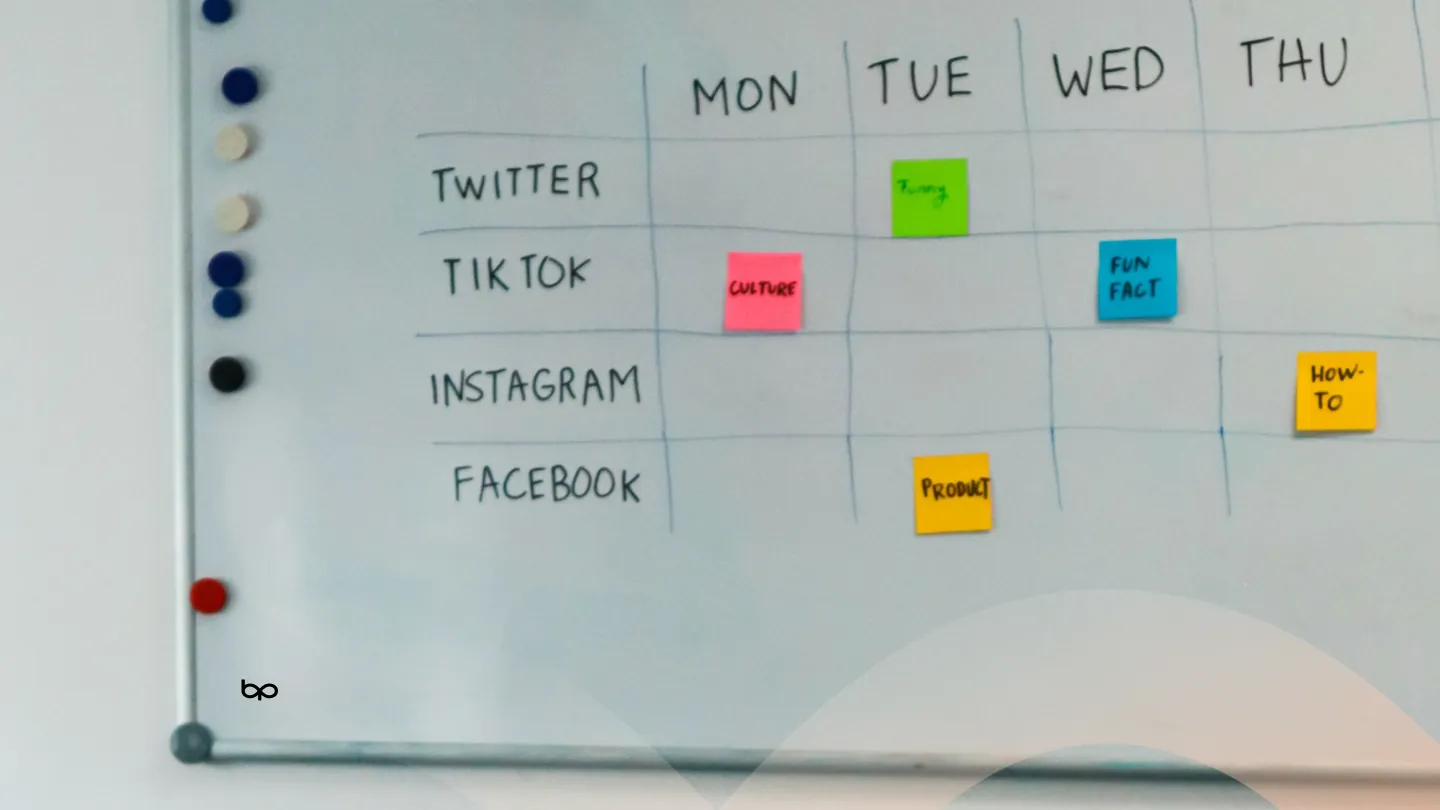

A social media audit is a stocktake: every account you own, what state it is in, what it published, and what it produced. It takes about four hours if you are organised and a week if you are not. The template below is the whole document, inline.
Most audit templates are gated downloads. This one is not. Copy the block, paste it, replace the bracketed placeholders.
The template
# Social Media Audit: [BRAND NAME]
**Audit date:** [DATE]
**Period reviewed:** [START DATE] to [END DATE]
**Auditor:** [NAME]

---

## 1. Account inventory

Every account that exists, including ones you forgot about.

| Platform | Handle | URL | Owner | Access | Status | Verified | Last posted |
|---|---|---|---|---|---|---|---|
| [PLATFORM] | @[HANDLE] | [URL] | [TEAM/PERSON] | [WHO HAS LOGIN] | [Active / Dormant / Unclaimed / Imposter] | [Y/N] | [DATE] |
| [PLATFORM] | @[HANDLE] | [URL] | [OWNER] | [ACCESS] | [STATUS] | [Y/N] | [DATE] |

**Accounts to close:** [LIST]
**Accounts to claim:** [LIST]
**Imposter accounts to report:** [LIST]

---

## 2. Profile consistency

| Item | [PLATFORM] | [PLATFORM] | [PLATFORM] | Consistent? |
|---|---|---|---|---|
| Display name | [VALUE] | [VALUE] | [VALUE] | [Y/N] |
| Handle | [VALUE] | [VALUE] | [VALUE] | [Y/N] |
| Profile image | [DESCRIBE] | [DESCRIBE] | [DESCRIBE] | [Y/N] |
| Bio / description | [VALUE] | [VALUE] | [VALUE] | [Y/N] |
| Link in bio | [URL] | [URL] | [URL] | [Y/N] |
| Contact email | [VALUE] | [VALUE] | [VALUE] | [Y/N] |
| Pinned / featured post | [DESCRIBE] | [DESCRIBE] | [DESCRIBE] | [Y/N] |

**Broken links found:** [LIST]
**Out-of-date claims in bios:** [LIST]

---

## 3. Audience

| Platform | Followers | Growth (12 mo) | Top country | Top age band | Gender split | Notes |
|---|---|---|---|---|---|---|
| [PLATFORM] | [N] | [+/-N] | [COUNTRY] | [BAND] | [SPLIT] | [NOTES] |

**Does the audience match the target customer?** [Y/N, with the mismatch named]

---

## 4. Publishing activity

| Platform | Posts in period | Posts/week | Longest gap | Most common format | Most common time |
|---|---|---|---|---|---|
| [PLATFORM] | [N] | [N] | [N days] | [FORMAT] | [TIME] |

**Cadence assessment:** [Consistent / Erratic / Abandoned]

---

## 5. Performance

| Platform | Impressions | Engagements | Engagement rate | Link clicks | Best format | Worst format |
|---|---|---|---|---|---|---|
| [PLATFORM] | [N] | [N] | [X.X%] | [N] | [FORMAT] | [FORMAT] |

**Top 10 posts of the period**

| # | Platform | Date | Post | Format | Reach | Eng. rate |
|---|---|---|---|---|---|---|
| 1 | [PLATFORM] | [DATE] | [TEXT] | [FORMAT] | [N] | [X.X%] |

**What the top 10 have in common:** [PATTERN, or "no clear pattern"]

---

## 6. Content review

| Content pillar | Share of posts | Share of engagement | Verdict |
|---|---|---|---|
| [PILLAR] | [X%] | [X%] | [Over / Under / Right-weighted] |
| [PILLAR] | [X%] | [X%] | [VERDICT] |

**Tone check:** [Does the writing sound like one brand across platforms? Y/N]
**Accessibility:** alt text on [X%] of images, captions on [X%] of videos.

---

## 7. Competitors

| Competitor | Platform | Followers | Posts/week | Eng. rate | What they do better |
|---|---|---|---|---|---|
| [NAME] | [PLATFORM] | [N] | [N] | [X.X%] | [ONE LINE] |
| [NAME] | [PLATFORM] | [N] | [N] | [X.X%] | [ONE LINE] |

**Gaps we could take:** [LIST]

---

## 8. Operations

| Question | Answer |
|---|---|
| Who approves posts before publishing? | [NAME / nobody] |
| Where does the content calendar live? | [TOOL] |
| Who has admin access to each account? | [SEE SECTION 1] |
| Is 2FA enabled everywhere? | [Y/N, list gaps] |
| Are there any personal accounts holding business access? | [Y/N] |
| Is there a documented social media policy? | [Y/N] |
| Is there a crisis / escalation path? | [Y/N] |
| Average response time to DMs and comments | [HOURS] |

---

## 9. Findings and fixes

| # | Finding | Severity | Fix | Owner | By when |
|---|---|---|---|---|---|
| 1 | [FINDING] | [High/Med/Low] | [FIX] | [NAME] | [DATE] |
| 2 | [FINDING] | [SEVERITY] | [FIX] | [NAME] | [DATE] |

**Top three priorities:**
1. [FIX]
2. [FIX]
3. [FIX]
How to fill each part in
Section 1 is the one people skip and the one that finds real problems. Search each platform for your brand name, not just the handles you know. Dormant accounts from an old campaign, a regional account someone set up, and outright imposters all show up here. Note who holds the login, because “an ex-employee’s personal email” is a finding in itself.
Section 2 needs a screenshot of each profile open side by side. Consistency is not a branding nicety: a bio linking to a dead landing page is lost traffic every day it stays up.
Sections 3 to 5 are data entry. Pull everything on one day, from one source per metric, and write the date down. Native insights and third-party analytics will not match exactly.
Section 6 requires a pillar list. If the brand has never defined its content pillars, define them first, then tag the last 50 posts by hand. Our content pillar generator is a quick way to get a starting set to tag against.
Section 7 should cover three competitors, not ten. You only have public numbers, so follower counts and post frequency are reliable and engagement rate is an estimate. Say so in the document.
Section 8 is the security and process pass. It is the section that gets an audit taken seriously by anyone outside marketing.
Section 9 is what you present. Severity has three levels because five levels means everything gets a 3.
What most people get wrong
Auditing only the accounts you remember. The dormant account with 400 followers and a 2019 bio is a live brand surface. Search properly.
Turning it into a performance report. An audit is structural. It asks whether the accounts, profiles, cadence and process are sound. Ongoing numbers belong in the monthly report, which is a different document with a different rhythm.
Reviewing 12 months of posts in detail. Review the last 90 days closely and the last 12 months at summary level. Anything older is a different strategy and a different algorithm.
Producing findings without owners. A finding with no name against it is an observation. Section 9 has an owner column for that reason.
Running it once. An audit’s value comes from comparison. Run it twice a year, keep the old ones, and put last audit’s numbers in a column next to this one’s.
Confusing “we post a lot” with “we post consistently”. The longest-gap column in section 4 tends to be more revealing than the total. Forty posts in one month and none in the next reads as forty posts a month in an average.
Turning findings into scheduled work
Most audits end with a fix list and no calendar, which is why the same findings appear in the next one. The two fixes that survive are usually cadence and approvals: pick a realistic weekly volume and put an actual approver in front of publishing.
Both are configuration rather than willpower. In BulkPublish, a fixed queue and calendar enforces the cadence you decided on, and approvals put a named reviewer between a draft and a live post so section 8 stops saying “nobody”. If the audit covered several brands, channel sets keep each one’s accounts separate at publish time.
The short version
Nine sections: inventory, profile consistency, audience, publishing activity, performance, content review, competitors, operations, findings. Pull all data on one day. Review 90 days closely, 12 months at a glance. Every finding needs a severity, an owner and a date. Run it twice a year and keep the old copies.