
These are questions that actually get asked in social media manager interviews, grouped by what they are testing. Under each is a note on what separates a good answer from a rehearsed one.
Whether you are preparing to answer or preparing to ask, the useful move is the same: work out what the question is really probing, then answer that.
Strategy and judgement
These separate people who execute a plan from people who can write one.
1. How would you approach our channels in your first ninety days? Good answers audit before they act. Expect: access and account hygiene first, then a look at what has actually performed, then a calendar. Weak answers arrive with a full content plan for a business they have not seen the analytics for.
2. Which of our current channels would you close? Tests whether the candidate will make a subtractive recommendation. A good answer names one, explains the cost of keeping it limping along, and is willing to be wrong.
3. How do you decide what to post? Look for a repeatable process tied to business goals, not “trends and what feels right”. Content pillars, a mix ratio, or a documented input from sales or support are all fine answers.
4. A competitor has ten times our followers. What do you do? The good answer questions the premise. Follower count is not the goal unless it has been made the goal. Look for someone who redirects to a metric that matters.
5. How do you adapt one idea across platforms? This is a competence question disguised as a strategy question. A strong answer describes changing length, format, hashtags, mentions and call to action per platform, not copying one post to five networks. The practical version of this is covered in what is cross-posting.
6. How much of the calendar should be planned versus reactive? There is no correct ratio, but there is a correct shape: a planned base with deliberate room for reaction. Someone who says “all reactive” cannot be relied on; someone who says “all planned” has never run a live account.
7. What would make you tell us to spend less on social? Rare and revealing. It tests honesty and commercial sense.
Execution and craft
8. Walk me through a post you wrote that performed well. Why did it work? The diagnosis matters more than the result. “It got 40,000 views” is not an answer. “It opened with a specific number instead of a claim, and the first three seconds showed the outcome” is.
9. Show me something you made that failed. The best single question in the set. Look for a real failure, an honest cause, and a change that followed. Candidates who cannot produce one either have not run enough, or are not honest about it.
10. How do you write a caption? Probing process, not talent. A hook, a specific structure, a call to action, and awareness of where the text gets truncated in feed are all good signals.
11. Can you edit short-form video yourself? A yes-or-no with a portfolio behind it. Be direct. This is now the most requested hard skill in the role, and it is easily verified.
12. How many posts a week can one person sustain across four channels? Tests realism. The right answer names a number and states the assumptions: production time, whether creative is provided, whether community management is included.
13. What does your publishing workflow look like? Look for someone who batches, schedules ahead, and does not publish manually from a phone at 9pm. The workflows in managing multiple social media accounts are the baseline expectation.
14. How do you handle approvals when someone else has to sign off? Especially relevant in regulated industries and agencies. Good answers have a named process and a deadline, not “I send it in Slack and chase”.
15. What is your process for building a month of content? Watch for the input stage. Strong candidates start from the business calendar, product launches and customer questions, not from a trends list.
Analytics and reporting
16. Which metrics do you report on, and why those? The best answer ties metrics to the goal and admits which are vanity. Reach, engagement rate, saves and shares, referral traffic and conversions are all defensible depending on the objective. A list with no reasoning is not.
17. Engagement is up but sales are flat. What is happening? Tests commercial thinking. Good answers explore audience mismatch, top-of-funnel content with no path onward, attribution gaps, or the possibility that social was never the constraint.
18. How do you calculate engagement rate? Surprisingly discriminating, because there are several definitions (by followers, by reach, by impressions). A good answer picks one, says why, and applies it consistently. Anyone can check their own maths with an engagement rate calculator; the point of the question is whether they know the denominators differ.
19. What does a monthly report from you look like? Ask to see one. Length is not the signal. A one-page report with commentary beats a 20-slide dashboard export.
20. How would you prove this role is worth the salary? Blunt but fair, and increasingly common. The strong answer picks a measurable line: pipeline, referral traffic, retention, support deflection, cost of the equivalent agency retainer.
21. How do you decide when to stop doing something? Tests whether they have kill criteria at all. Most people do not.
Community and crisis
22. A customer posts a public complaint that is factually correct. What do you do? Acknowledge, do not argue, take it to a private channel for resolution, and follow up publicly if it is resolved. Watch for anyone whose instinct is to delete or hide.
23. A post you scheduled goes out during a national tragedy. Walk me through the next hour. Tests preparedness. Good answers pause the queue first, then assess, then communicate internally. The scheduling-pause step is the tell for someone who has actually been through it.
24. Where is the line on responding to trolls? Look for a stated policy rather than a mood. Reply once with facts, then stop; hide rather than delete abuse; escalate threats.
25. How do you handle a founder or executive who wants to post something you think is a mistake? Tests whether they can disagree upward without being obstructive. Good answers offer an alternative rather than only a refusal, and know when the decision is not theirs.
26. What is your response-time target for DMs and comments? There is no universal right number, but there should be a number, and it should match the resourcing.
Fit and motivation
27. Why this company’s audience specifically? Tests whether they did any preparation beyond the careers page. A candidate who names a post of yours that worked, and says why, is ahead of the field.
28. What part of this job do you not enjoy? Everybody dislikes some of it. The honest answers are usually community management volume or reporting. Someone who claims to love all of it is either new or performing.
What the candidate should ask the employer
An interview where the candidate asks nothing is a bad signal, and most candidates ask nothing useful. These are the questions that actually change whether you should take the job.
- How many channels, and what posting volume is expected on each? Get the numbers before you accept.
- Is paid budget part of this role? How much? This determines both the work and the salary band. If it appears after you start, the role has changed.
- Who produces the creative? If the answer is “you”, the workload is roughly double what the listing implies.
- What does the person doing this today spend their week on? If there is no such person, ask who has been doing it and why they stopped.
- What will I be measured on at the six-month review? If nobody can answer, the role has no definition and you will be judged on vibes.
- Who signs off on posts, and how long does that take? A two-day approval loop makes reactive content impossible. Better to know now.
- What is the budget for tools? A social role with no tooling budget is a role that will be done by hand.
- How does social work with sales, support and product? Isolation is the most common reason good social managers leave.
- What happened to the last person in this role? Ask it plainly.
- What is the salary range, and how are increases decided? Ranges vary enormously by source and by scope: the comparison in the social media manager salary guide is worth reading before this conversation.
The short version
- Strategy questions test whether you audit before you act
- Craft questions test whether you can produce, not just plan. Bring a failure as well as a win
- Analytics questions test whether you can explain a result, not export one
- Crisis questions test preparedness, and the pause-the-queue instinct is the tell
- As a candidate, ask about channel count, creative ownership, paid budget and the six-month measure. Those four determine whether the job is doable
The practical exercise many interviews now include
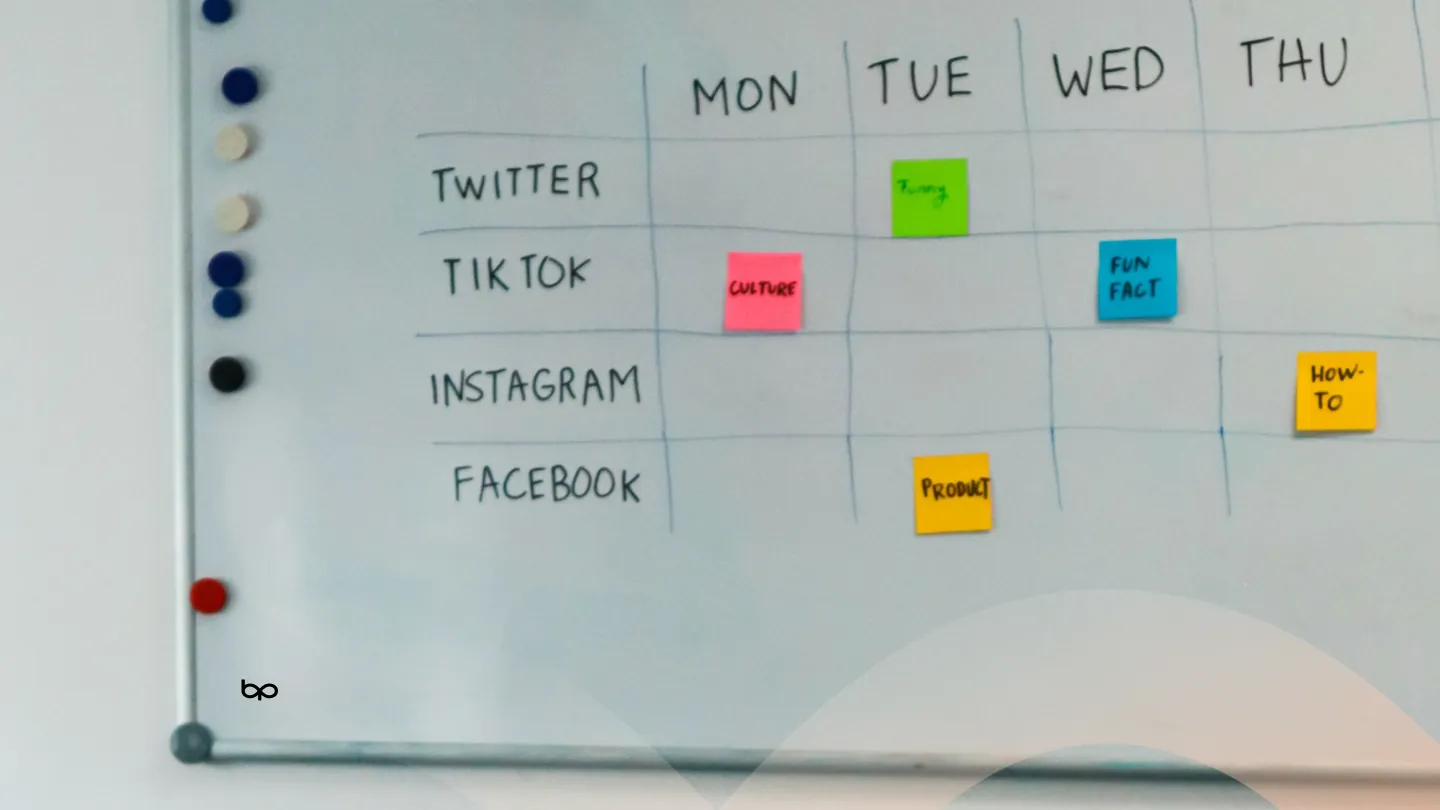
A common final stage is a paid exercise: plan a week or a month of content for one of the employer’s channels. It should be paid, it should be scoped, and it should not be a full campaign for free.
If you get one, the thing that impresses is usually not the ideas. It is showing the plan as a calendar with realistic volume, the per-platform adaptation, and a note on what you would measure. BulkPublish’s calendar view is one way to present that (the free tier covers 3 channels, 1 post a day, which is enough for an exercise), though a spreadsheet is perfectly acceptable if it is clear.